Quick answer
- Most regular lobe earrings are 20 gauge (0.8mm) or 18 gauge (1.0mm).
- Cartilage and body jewelry is commonly 16 gauge (1.2mm).
- In gauge sizing, a smaller number means a thicker post.
- Going thinner is easy; going thicker may need gentle tapering.
Gauge converter
If you've ever wondered what gauge are regular earrings, the short answer is 20 gauge or 18 gauge. Most fashion and fine jewelry for the lobe uses a post around 0.8 to 1.0mm thick. Body jewelry for cartilage tends to be a bit thicker, usually 16 gauge.
That small difference matters more than you'd expect. It decides whether a new pair slides in easily, whether a piercing feels tight, and whether two earrings will share the same backs.
Regular earring gauges at a glance
| Gauge | Millimeters | Inches | Where you see it |
|---|---|---|---|
| 22g | 0.6mm | 0.025 in | Very fine fashion hooks |
| 20g | 0.8mm | 0.032 in | Most standard lobe studs, hooks and hoops |
| 18g | 1.0mm | 0.039 in | Sturdier lobe earrings, many piercing studs, some nose jewelry |
| 16g | 1.2mm | 0.047 in | Helix, tragus, conch, rook and other cartilage jewelry |
| 14g | 1.6mm | 0.063 in | Industrial bars, some lobe body jewelry |
A loose rule: if it came from a department store jewelry counter, it's probably 20g. If it came from a piercing studio, check the label, because it may be 18g or 16g.
Why a smaller gauge number means a thicker post
Gauge comes from the old wire-drawing trade. Wire was pulled through a series of dies, each one making it thinner, and the gauge number roughly counted how many times it had been drawn. More passes meant thinner wire and a bigger number.
That's why 20g is thinner than 18g, and 18g is thinner than 16g. Once you get past 0g, the scale continues as 00g and then switches to fractions of an inch. Our full ear gauge size chart covers every step from 20g to 1 inch.
Cartilage piercings and 16 gauge
Professional piercers commonly use 16g for cartilage, though some use 18g or 14g depending on the placement and your anatomy. A slightly thicker post resists migration and gives the channel more support as it heals.
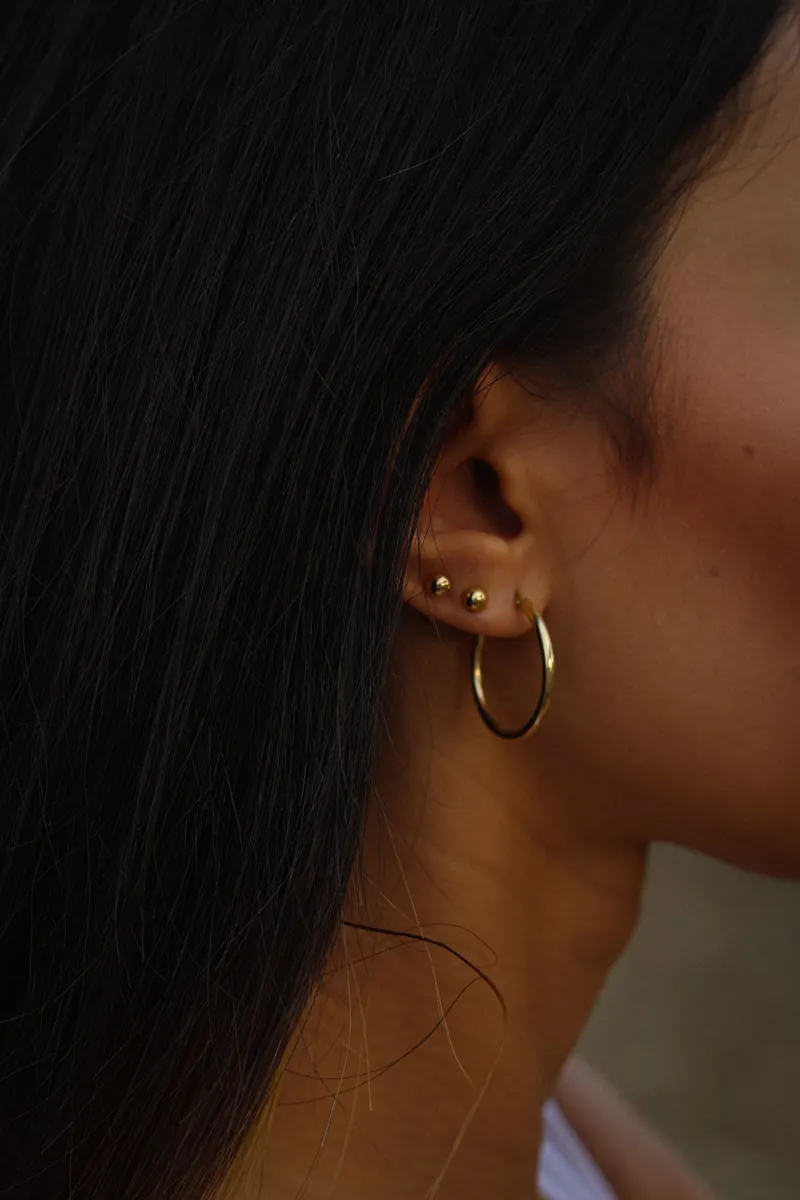
This is why your favorite little 20g stud may feel loose in a helix piercing, or why a labret-style flat back from a studio feels chunky in your lobe. If you're building a stack like the one pictured, it helps to know which holes take which gauge before you shop. Explore more ideas in our cute cartilage earrings guide.
For any fresh piercing, an APP-member piercer will usually start you in implant-grade titanium or 14k+ solid gold, at whatever gauge suits your anatomy. Keep it in until healed before switching to fashion jewelry.
What gauge are regular earrings from different sources?
Where you buy matters. Fine jewelers and big-name fashion brands overwhelmingly use 20g posts for lobe studs and hooks, with some heavier hoops at 18g. Piercing guns at mall kiosks historically used thicker, blunt studs, which is one reason professional piercers prefer needles.
Studios that sell threadless or internally threaded jewelry often offer lobe pieces in 18g or 16g. These are excellent quality, but they won't fit a pierced ear that has only ever worn 20g without a little coaxing.
How to tell what gauge an earring is
- Check the listing or packaging. Body jewelry is almost always labeled in gauge; fashion jewelry often isn't.
- Measure the post. A digital caliper is the most reliable. Around 0.8mm is 20g, 1.0mm is 18g, 1.2mm is 16g.
- Compare by feel. Hold the unknown earring next to one you know. The thicker post is usually obvious side by side.
- Test the back. A butterfly back made for 20g will slide loosely on a thinner post and won't fit a thicker one.
Switching between gauges safely
Going thinner is easy. A healed 18g or 16g lobe will happily accept a 20g earring, though it may feel a little loose and the back may need to sit closer.
Going thicker takes more care. A healed lobe that has only ever worn 20g can often accept 18g with a little lubrication and patience. Moving from 20g up to 16g or 14g is a small stretch, so go slowly.
- Wash your hands and clean the jewelry.
- Use a tiny amount of water-based lubricant or a plain, fragrance-free balm.
- Insert from the front at the same angle as the channel; never force it.
- If you feel sharp pain or resistance, stop. A piercer can use a taper to guide the jewelry in gently.
If a piercing becomes red, swollen, hot or starts to discharge after a switch, take a break from that jewelry. See a doctor if it doesn't settle or you notice fever or spreading redness. Thicker or thinner, the right gauge is the one your ear wears without complaint. To match posts with the right closures, see our guide to types of earring backs.
Frequently asked questions
What gauge are normal earrings?
Normal lobe earrings are usually 20 gauge (0.8mm) or 18 gauge (1.0mm).
Is 18g or 20g bigger?
18g is thicker. In gauge sizing, a lower number means a thicker post, so 18g (1.0mm) is thicker than 20g (0.8mm).
Can I wear 20g earrings in a 16g piercing?
Yes, a healed 16g piercing will accept a thinner 20g earring. It may feel slightly loose but is generally fine.
What gauge is a cartilage earring?
Cartilage jewelry is most often 16g (1.2mm), though some piercers use 18g or 14g depending on placement.