Quick answer
- A 5mm stud is about 0.2 in across, roughly the width of a pencil eraser minus a sliver.
- 3mm is dainty (peppercorn), 4mm is subtle, 6mm starts to read clearly from across a room.
- For a round diamond, 5mm is approximately 0.5 carat per earring.
- Measure across the widest point of the face, including any halo or setting.
See it to scale
The copper coin is a US penny (19.05 mm) for scale.
Want it calibrated to your screen? Open the full Earring Size Tool.
Product photos are zoomed in, so a stud that looks bold online can turn out to be a speck in real life. Knowing the 5mm earrings actual size (and its neighbors) is the fastest way to stop guessing. A 5mm stud measures about 0.2 inches across: noticeable, polished, and still small enough to wear every day.
Below you'll find every common stud size side by side, plus a simple way to check a stud you already own. If you'd rather see them life-size, our earring size tool lets you see them to scale on your screen.
Stud sizes from 2mm to 10mm, compared
Stud sizes describe the diameter of the visible face, measured edge to edge. Inches are rounded to the nearest thousandth (1 mm = 0.03937 in), and the comparisons are approximate.
| Size | Inches | About the size of | Look and who it suits |
|---|---|---|---|
| 2mm | 0.079 in | A pinhead | A glint, not a statement. Great for upper lobe or cartilage stacks. |
| 3mm | 0.118 in | A peppercorn | Dainty and minimal. Kids, second holes, sleep-friendly studs. |
| 4mm | 0.157 in | A lentil | Subtle but visible. Office-safe, petite lobes. |
| 5mm | 0.197 in | A pencil eraser, slightly trimmed | The everyday sweet spot. Reads clearly without shouting. |
| 6mm | 0.236 in | A pencil eraser | Classic first-lobe stud. Visible across a table. |
| 7mm | 0.276 in | A large pencil eraser | Confident. Good for fuller lobes or evening. |
| 8mm | 0.315 in | A chickpea | Statement stud, the size of many classic pearls. |
| 10mm | 0.394 in | Just over half a dime | Bold. Covers much of a smaller lobe. |
5mm earrings actual size: how big are they really?
Picture the eraser on a standard pencil, which sits around 6 to 7mm, then shave a little off the edge. That's a 5mm stud. On most adult lobes it sits comfortably in the middle with visible skin all around it.
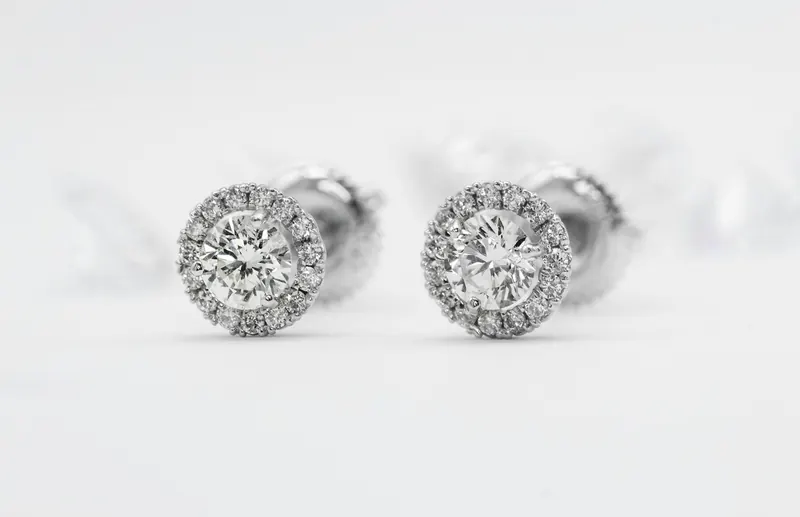
In carat terms, a well-cut round diamond of 5mm is approximately 0.5 carat, so a pair of 5mm diamond studs is roughly one carat total weight. Lab-grown, moissanite and cubic zirconia of the same diameter look the same size, even though their weights differ.
A halo changes the math. A 4mm center stone inside a halo can measure 6 to 7mm overall, so check whether a listing quotes the stone or the full face.
3mm, 4mm and 6mm: the sizes people mix up
How big is 3mm?
About an eighth of an inch. A 3mm stud is the classic tiny sparkle: it looks lovely in a second or third hole and almost disappears in a first-hole lobe on its own. It's also a popular choice for kids because it's light and low-profile.
4mm earrings actual size
At roughly 0.16 inches, 4mm is the size people pick when they want something they never think about. It shows up in photos but won't compete with glasses, a scarf or a big necklace. If you're building a curated ear, 4mm pairs well next to a 6mm lead stud.
6mm studs
Just under a quarter inch, 6mm is the size most jewelers call a standard everyday stud. It's the point where pearls and diamonds read as intentional from a few feet away. If 5mm feels a touch safe, 6mm is the natural step up. For the larger end, see our guide to 8mm earrings actual size.
How to measure a stud at home
You don't need special tools. A ruler with millimeter marks works, and a credit card (85.6 x 53.98mm) is a handy sanity check if you suspect your ruler is off.
- Lay the earring face-up on a flat, light-colored surface.
- Place the ruler across the widest point of the face, including any halo, prongs or bezel.
- Look straight down from above so you aren't reading the scale at an angle.
- Round to the nearest half millimeter. Most studs are sold in whole or half sizes.
Once you know the size of a stud you love (or one that felt too small), you have a reference point for every future purchase. Write it down in your phone notes and compare listings against it.
Choosing the right size for your ear
Lobe size matters more than age or face shape. A small lobe makes a 5mm stud look generous, while a long lobe can carry 7 or 8mm easily. Your piercing placement matters too: a hole set high on the lobe leaves more space below, which makes studs look smaller.
- First hole, everyday: 5 to 6mm is the safest bet.
- Second and third holes: step down 1 to 2mm each time for a graduated look.
- Cartilage: 2 to 4mm keeps things comfortable and snag-free.
- Sleeping in them: flat-backed, smaller studs are easier. See our guide to types of earring backs.
And remember that mismatched is allowed. A 5mm stud in one ear and a tiny 3mm cluster in the other is exactly the kind of charmingly out-of-place pairing we love. If you're after a broader look at styles beyond studs, browse our rundown of types of earrings.
Screens vary in pixel density, so any on-screen size chart is a close approximation. Calibrate a digital viewer with a credit card for the most accurate preview.
Frequently asked questions
How big are 5mm earrings in inches?
A 5mm earring is about 0.197 inches, or just under a fifth of an inch, across its face.
Are 5mm studs too small?
For most adult lobes, 5mm is a balanced everyday size that is clearly visible without being flashy. If you want them noticed from across a room, consider 6 or 7mm.
What carat is a 5mm diamond stud?
A well-cut round diamond measuring 5mm is approximately 0.5 carat, so a pair is roughly 1 carat total weight. Cut proportions shift this slightly.
Is 4mm or 5mm better for a second hole?
If your first hole wears a 5 or 6mm stud, a 4mm or smaller stud in the second hole creates a pleasing graduated look.